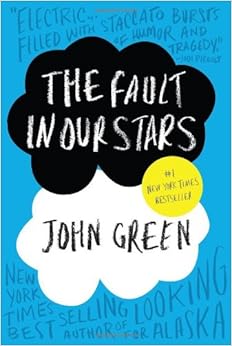
My interest was piqued by their overly enthusiastic reactions; I mean it means that the book must be at least vaguely enjoyable right? After that I found that the author is a guy called John Green, who also had a YouTube Channel. The interesting thing though is that he has a channel on SCIENCE while The Fault in Our Stars is essentially a book about LOVE. This made me very, very intrigued about how the subject matter will be treated in this book so I went ahead and read it.
The book itself was not bad (the movie was quite a letdown). Green tries to marry two difficult subject matters (teen cancer with teen love) and it works quite wonderfully in the narrative. The only thing that made me cringe was when he tried to squeeze as many metaphors about stars and infinities and etc to make the book seem more 'romantic' and 'deep' than it really is (ie. trying too hard to be smart in my honest opinion). Kids will not know the difference though so I would definitely introduce this book to my students. The language used is not as childishly terrible as Twilight and the subject matter would open up a lot of interesting discussions within the classroom.
The Boy in Striped Pyjamas

Another book that I just had to read because someone had a strong reaction to it. I think Stephanie was saying in class that she thought this book was very childlike and too simple to use in the classroom and she sounded like she really hated the book (lol). So naturally, I just had to read it!
After reading the first few pages, I totally understood where Stephanie was coming from. The language really is way too simple that it becomes annoying to read especially the parts where Bruno keeps repeating descriptions over and over again. The whole thing was just very infuriating for me personally. That said, I think this book is more suitable for Secondary 1 or 2 students due to the difficulty level. The only thing that might be challenging about teaching the book in class would be that the teacher will have to extrapolate on the historical context of the book and I personally feel that it is good to combine history with literature just so that the kids can see how literature can have relevance to the rest of the world. Will i read this book again? NEVER.
Percy Jackson Series

I have read the entire Percy Jackson series and I'm not afraid to admit it! What got me into it? Once again, it is due to a person's very strong opinion of it. When I was doing my contract teaching, I had this one boy in class that will lug these books around every single day and insists on reading them in class. He would usually put it away when I asked him to but he would never fail to bring a new Percy Jackson book every few weeks. So one day I asked him about it and he told me that he just loved the entire series and everything is awesome etc etc.
At that point of time, I was bugged down by a lot of work and wanted to read simple, enjoyable books that required not much thinking/literary analysis/heavy subject matter etc so I was like wow okay, maybe I should give these books a try. At 25 years old, all I can say is that I LOVE THE BOOKS. Its such a simple book to read and I've always loved greek mythology either way
so it was (as my student said) "awesome".I would totally use these books in class however only at a lower secondary level. I think it is still far too simple to be considered a 'true literary' text (in the typical sense) but I still see the value that it has to engage younger audiences or kids who do not like reading in the first place.
Ps. there are serial continuation for the series above; one for the roman gods and one for egyptian gods.

No comments:
Post a Comment