That was my initial impression of this assignment. Yet, writing this now in the shadow of the Arthouse seminar (Reinventing English Language and Literature for a New Generation), this exercise seems to carry a kind of psychological baggage that this report, is a reflection of how the future teachers of literature see the field and address the needs of our future students. Taking into consideration their developmental needs as young adults, and being cognizant about the need for appropriate exposure of texts, I have selected John Green's An Abundance of Katherines (2006), Anita Desai's Fasting Feasting (1999) and finally, Cyril Wong's collection of poetry in Straw, Sticks, Brick (2012) alongside the guidelines impressed by the assignment details.
An Abundance of Katherines (2006) by John Green
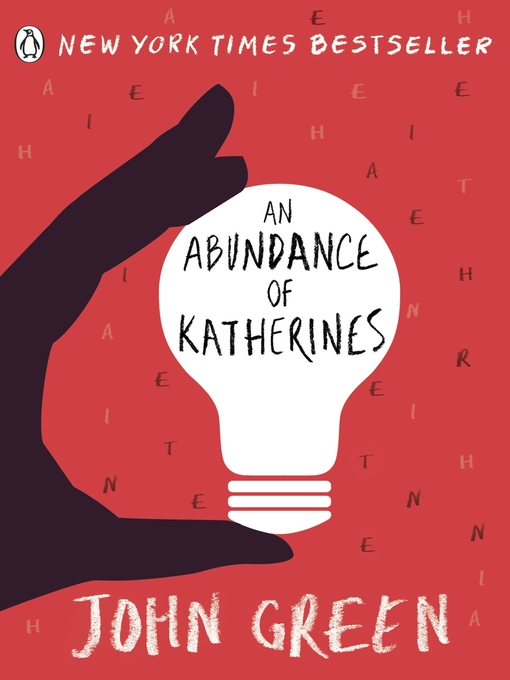
Green's coming-of-age novel follows the adventure of young Colin Singleton. As his name implies, one of the key
problems faced in his life is his perpetual singlehood. Colin has been dumped
19 times, by 18 different Katherines. As a little-known prodigy with
a knack for processing large amounts of information and coding anagrams, Colin is slowly coming to terms that he might not be as special as he thinks he is. The
narrative follows Colin and his best friend, Hassan as they take a roadtrip to
“find” themselves after Colin is dumped by the nineteenth Katherine. Amidst the
dozens of signs that dot the freeway, Colin inexplicably focuses his attention that
point towards Gutshot – the final resting place for the Archduke Franz
Ferdinand (the man who historically caused WWI). They meet Lindsey Lee Wells at
the town of Gutshot and what follows is a series of incredible adventures that
the trio undertake in a town whose chief produce is tampon strings. Through the month-long adventure/misadventures of documentary production, hunting and social interactions with the good people of Gutshot, the narrative gently unpacks hard hitting issues alongside the gradually maturing mindsets of Colin, Lindsey and Hassan.
To be honest, Green's narrative was some of the most enjoyable reading I had done in a long while. The pace of the narrative is light-hearted, but underneath that, An Abundance of Katherines is anything but light-weight in terms of the issues it deals with. What struck me particularly is how it brings about the introspection of the self in an easily accessible manner. Green's attempt to capture the thoughts and internal monologues that a teenage boy would have is uncanny - I found myself agreeing to some of the theorems that Colin has portrayed (having dabbled and written a little about such ideas while I was growing up). This introspection of self, coupled with the exploration of romantic relationships - I assume - would be interesting to students who are becoming aware of their gender, and their position in relation to society. Colin's obsession with anagrams serve as a good starting point for teachers to explore the codified nature of language - or to put it in more technical terms - Colin's obsession with anagrams allows teachers to explore the structuralism/post-structuralism dichotomy within the literary canon.
Green's text, however, comes with certain problems of its own. For one, a portion of An Abundance of Katherines deals with sex, guns and coarse language. In the cultural context which the text is written (America), these details serve to enrich the flavour of the narrative and could be framed as such. Yet, the degrees of promiscuity suggested by the book - two minor characters within the book (TOC - the other 'Colin' and Katherine were 'fucking' each other when they were discovered by Colin and Hassan) were cheating on their partners and engaged in pre-marital sex - might be too much for the parents of our students to handle. The challenge that this poses to the normative core of our society's values might see strong resistance against the use of this text in classrooms, where teachers might be accused of corrupting young minds.
Fasting Feasting (1999) by Anita Desai

My first interaction with Desai's text came from my ESE at Chung Cheng High (Yishun). This was their chosen syllabus text for the pure Literature cohort - and I remember thinking out loud to myself - well, this is not an easy text to tackle, even for Pure Literature students. There are a lot of ideological bearings that require extensive unpacking. Set in modern-day India, Fasting Feasting follows the lives of an Indian family as they move through the different stages of their lives. The narrative structure is challenging - firstly, the story is demarcated into two clear portions that are loosely connected by a seemingly unbiased omniscient narrator.
The two-parter within this novel forces the reader to follow two distinctively different characters - in the first part, Uma, the 'wronged' first-child / daughter takes centre stage as Desai uses her to deftly maneuvere the complex landscape that is the position of women in India in post-colonial times. The reader is re-positioned and displaced to America to witness the problems that Arun - the only male child of the family - faces in his attempt to integrate into the American culture even as he attempts to come to terms with his own sexuality. In this sense, Desai's works centre strongly around the social construction of gender, a thematic concern that clearly invokes a strong feminist slant. What is also apparent through the two-parter is the East-West dichotomy that it creates, underscoring a possible post-colonial agenda.
Complicating Desai's text is the fact that even the minor characters play important roles in developing the central theme. The women which Uma interacts with in part 1 serve as foils to develop the complex and sometimes contradicting nature of women in India (the perfect woman, Anamika, the modern woman, her sister Aruna, and the religious aunt, Mira-masi), and the same can be said for Arun in the second arc of the story.This places a lot of pressure on the reader to seek out the nuances in the stories that an otherwise less careful reader might simply term as extended exposition by the author. The fact that much of the context of the narrative is based in India further serves to distance local readers from the issues that are being surfaced in Desai's text.
These being said, the difficulty which the text presents is also, perhaps, its strongest redeeming feature - it presents a richness that allows readers and teachers to slowly unpack the multiple layer of meanings. Its hard-hitting topics (gender, identity and post-colonial tension) serve as a starting point that allow our students to become more aware of global issues and the various contemporary conversations that they will have to deal with in their lives.
Straw, Sticks, Brick (2012) by Cyril Wong
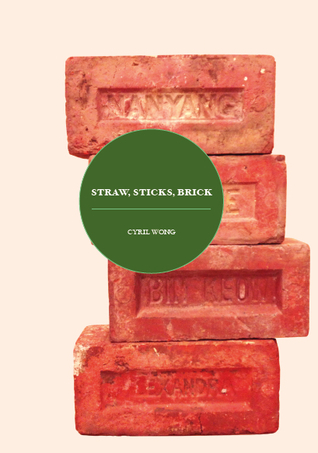
Rounding of the selection of texts here is a collection of prose-poems by local writer Cyril Wong. As a reader, my inclination has always been towards the prose genre simply because I enjoy the experience of inhabiting the world that a novel creates as compared to transient, ephemeral scenes which poetry is often situated in.
As a Singaporean reader of Cyril's poetry, I cannot help but to notice that the poems are pregnant with allusions that attempt to address social issues faced by Singaporeans. Lamentations - a poem within this particular collection, contains a particularly poignant line - about how we "drown in dreams of lack" - a particularly sharp ending line with a poem that deals with the lack of ambition in individuals. Other poems within the series draw the reader's focus to themes that traditionally remain silent and lie on the periphery of society. Suicide (After Albert), Homosexuality (Born this Way) are some of the themes covered within this collection amidst other poems that deal with family (History of Family), religion (Genesis, The Apples) and identity (Fuck the Ontologists).
Compared to the other poetry anthologies - Little Things for instance, Cyril's works in comparison, is more raw and hard-hitting with its subject matter. A teacher would be hard-pressed to deliver a full unit based on Cyril's text which crosses many OB lines that our society has adopted a purposefully ambiguous stance on, and definitely has his/her work cut out as unpacking ideas of death, sexual orientation, identity, hopes and dreams, are surely messy processes. Again, the merits lie in the difficulty, again, because these are the ideas and thoughts that even we as adults, are trying to unpack and come to terms with.
Cyril's works have often been mentioned in class in passing, and I would like to take the opportunity in closing to share one of the works that has impacted me in my reading of this anthology. The namesake of the anthology comes from this poem.
Straw, Sticks, Brick
by Cyril Wong
What was the word again: the ensuing frustration, that long clawing
across the inside of a skill; and what if the word is not the only
loss; memories, people affections; would it be terribly important to
mourn; the body still dreaming to become a hoop the world jumps
through; an execution swift, but barely memorable; how long before
we accumulate again; the self as a straw-house; now sticks, now brick;
and then the word returns - unendurable relief, everything else
flying back into place; straw, sticks, brick; bursting invulnerability,
the greatest return of fear; unsettling beneath the surface, a tremor;
hairline fracture behind the wallpaper; yet are we not gleeful for the
moment, prancing like children with arms weightless against the
ceiling?

Zhonghao,
ReplyDeleteI think the choice of using a local poet's collection of poem seems really interesting. (The book cover is already enticing enough to me, at least HAHA) -- and I don't usually enjoy local works. I think I would be inclined to try reading it :D
I also think Green's text seems fun as an exposure text too. We can indeed show the children the "world out there" and explore even popular texts right now with them and make good meaning in relation to their lives as well. I think this is what Literature is about too, learning about an appreciation of different writing and worlds. :D
That's the Math Paper Press design :)
DeleteHi Zhong Hao, Cyril's confessional poetry has some gems but as collections, my personal thoughts are that his works make more for wonderful personal reading than school collections. Individual poems are great for using to discuss issues that are relevant to our students and to our world at large.
ReplyDelete